
The construction industry continues to experience unprecedented growth, driving demand for skilled crane operators to new heights. Whether you're looking to enter this lucrative field or advance your existing career, understanding crane operator training requirements is essential for success. Professional certification not only ensures workplace safety but also opens doors to higher-paying positions and greater job security.
Crane operation is a specialized skill that requires comprehensive training, hands-on experience, and official certification. The stakes are high—crane operators handle equipment worth millions of dollars while working in environments where safety is paramount. This makes proper training and certification not just beneficial, but absolutely critical for anyone serious about pursuing this career path.
In this comprehensive guide, we'll walk you through everything you need to know about crane operator training requirements, from basic prerequisites to advanced certification processes. You'll discover the various types of training available, understand the certification steps, and learn what it takes to build a successful career in crane operation. By the end of this guide, you'll have a clear roadmap to achieving your certification goals and entering one of the construction industry's most rewarding professions.
Understanding Crane Operator Training
Crane operator training encompasses a comprehensive educational program designed to teach individuals the skills, knowledge, and safety protocols necessary to operate various types of cranes safely and efficiently. This specialized training combines theoretical knowledge with practical, hands-on experience to ensure operators can handle the complex responsibilities of crane operation in real-world construction environments.
The importance of certification in the construction industry cannot be overstated. Professional certification serves as proof that an operator has met rigorous industry standards and possesses the competency required to operate heavy equipment safely. Employers increasingly require certified operators to minimize liability, ensure compliance with safety regulations, and maintain insurance coverage. Certification also demonstrates a commitment to professionalism and ongoing education, making certified operators more attractive to potential employers.
The National Commission for the Certification of Crane Operators (NCCCO) stands as the premier certifying body for crane operators in North America. Established in 1995, NCCCO has become the gold standard for crane operator certification, recognized by major construction companies, government agencies, and safety organizations worldwide. The organization develops comprehensive testing programs that evaluate both theoretical knowledge and practical skills, ensuring certified operators meet the highest industry standards.
NCCCO certification is widely accepted across the construction industry and is often required by employers, insurance companies, and regulatory bodies. The commission's rigorous standards help maintain consistency in operator competency while promoting workplace safety. Understanding crane operator training requirements begins with recognizing NCCCO's role as the authoritative source for certification standards and procedures. This foundation knowledge is crucial for anyone considering a career in crane operation or seeking to advance their existing skills in heavy equipment operation.
Basic Requirements for Crane Operator Training
Before enrolling in crane operator certification programs, candidates must meet specific basic requirements that ensure they can safely participate in training and successfully operate heavy equipment. Understanding these crane operator training requirements is essential for planning your certification journey and ensuring you're prepared for the demands of professional crane operation.
Age requirements form the foundation of eligibility criteria. Most training programs require candidates to be at least 18 years old, though some specialized programs may accept younger participants with proper supervision and parental consent. This age requirement reflects the maturity and responsibility needed to operate equipment that can weigh hundreds of tons and work in high-risk environments.
Health requirements are equally important, as crane operation demands excellent physical and mental capabilities. Candidates must demonstrate good vision, including depth perception and color recognition, which are crucial for safe equipment operation. Hearing must be adequate to communicate with ground personnel and detect equipment sounds that indicate potential problems. Physical fitness requirements include the ability to climb equipment, work at heights, and maintain concentration for extended periods. Many programs require a medical examination or physician's clearance before enrollment.
Educational background requirements are typically minimal but important. Most programs require a high school diploma or equivalent, though some may accept candidates with relevant work experience in lieu of formal education. Basic literacy and numeracy skills are essential, as operators must read technical manuals, understand load charts, and perform calculations related to lifting capacity and equipment positioning.
Prerequisite experience varies by program and certification level. Entry-level programs typically welcome candidates with no prior crane experience, providing comprehensive foundational training. However, having general construction experience, mechanical aptitude, or experience with other heavy equipment can be advantageous. Some advanced certification programs may require documented hours of crane operation or completion of basic certification levels.
Additional requirements often include a clean driving record, as many crane operators must transport equipment between job sites. Background checks may be required, particularly for positions involving government contracts or sensitive work sites. Drug and alcohol screening is standard in most programs, reflecting the industry's commitment to safety and the zero-tolerance policy for substance use in heavy equipment operation.
Types of Crane Operator Courses Offered
The crane operation field encompasses various specialized equipment types, each requiring specific training and certification. Understanding the different crane operator courses available helps you choose the right training path for your career goals and ensures you meet the specific crane training requirements for your target employment opportunities.
Mobile crane courses represent the most common type of crane operator training, covering equipment that can travel on public roads and move between job sites. These courses focus on truck-mounted cranes, rough terrain cranes, and all-terrain cranes. Students learn load chart interpretation, rigging principles, and equipment inspection procedures specific to mobile equipment. Training covers setup procedures, outrigger positioning, and the unique challenges of operating cranes on various terrains and in different weather conditions. Mobile crane certification is often considered the entry point for many crane operators due to the widespread use of this equipment type across construction projects.
Tower crane courses address the specialized requirements of operating fixed cranes commonly used in high-rise construction and large commercial projects. These programs cover the unique aspects of tower crane operation, including climbing procedures, load handling at significant heights, and coordination with multiple construction crews working simultaneously. Students learn about tower crane assembly and disassembly, weather-related operational limitations, and the specific safety protocols required when working above occupied buildings. The training emphasizes precision control and communication skills essential for successful tower crane operation.
Lattice crane courses focus on large, complex cranes used for heavy lifting applications in industrial construction, bridge building, and infrastructure projects. These powerful machines require specialized knowledge of boom configurations, counterweight systems, and complex rigging arrangements. Training covers load moment calculations, boom angle optimization, and the coordination required for multi-crane lifts. Students learn about the unique maintenance requirements and inspection procedures for lattice boom cranes, as well as the specialized transportation and assembly procedures these machines require.
Rigger and signal-person training courses complement crane operator certification by teaching the critical support roles essential for safe crane operation. Rigging certification covers proper sling selection, load calculation, and attachment techniques that ensure loads are securely connected to crane hooks. Students learn about different rigging hardware, weight distribution principles, and hazard identification. Signal person training focuses on standardized hand signals, radio communication protocols, and the responsibilities of directing crane operations when operators cannot clearly see the load or landing area.
The differences in training approaches reflect the varying complexity and specialization required for each equipment type. Mobile crane training typically emphasizes versatility and adaptability, preparing operators for diverse job sites and equipment configurations. Tower crane training focuses on precision and consistency, as these operators work in more controlled but highly complex environments. Lattice crane training emphasizes engineering principles and project coordination, as these cranes handle the most challenging lifting operations in construction.
Certification Process Steps
Achieving crane operator certification involves a systematic process that ensures candidates meet rigorous industry standards for safety, competency, and professionalism. Understanding each step of the certification process helps you prepare effectively and navigate the requirements successfully, ultimately leading to NCCCO certification that opens doors to rewarding career opportunities.
Finding an accredited training provider represents the crucial first step in your certification journey. Look for training organizations that offer NCCCO-approved programs and have established reputations in the industry. Accredited providers maintain current curriculum standards, employ qualified instructors with extensive field experience, and provide access to modern equipment for practical training. When evaluating training providers, consider factors such as class schedules, equipment availability, and instructor qualifications. Miller Crane Works does not offer job placement.
Completing the required coursework forms the foundation of your certification preparation. Classroom instruction typically covers crane operation principles, safety regulations, load calculations, and equipment maintenance procedures. Students learn to interpret load charts, understand rigging principles, and identify potential hazards in crane operations. The coursework includes study of OSHA regulations, industry standards, and best practices that govern safe crane operation.
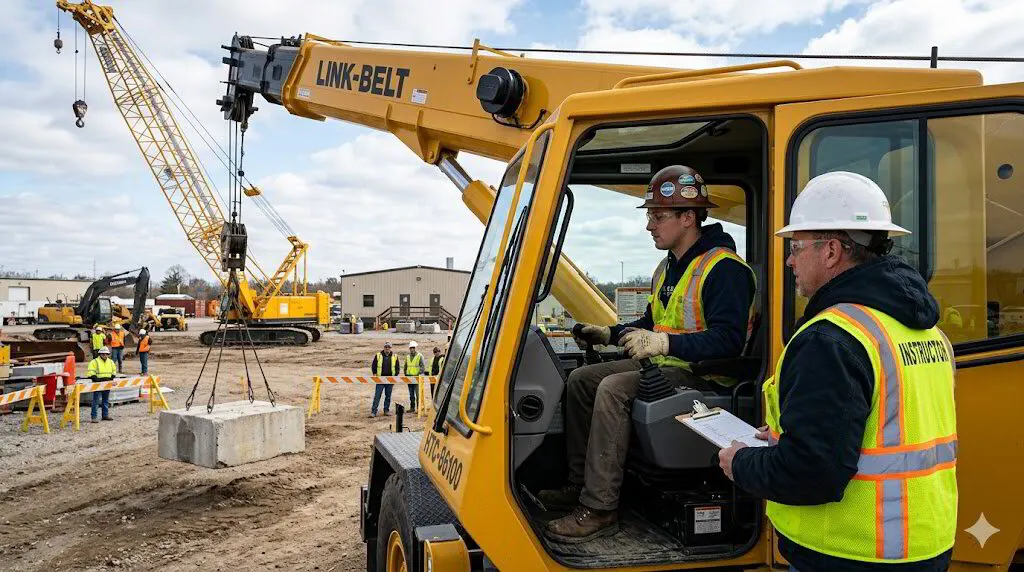
Practical training sessions provide hands-on experience with actual crane equipment under professional supervision. These sessions allow students to apply classroom knowledge while developing the muscle memory and spatial awareness essential for safe crane operation. Practical training covers pre-operational inspections, basic equipment operation, load handling techniques, and emergency procedures.
The written examination tests theoretical knowledge and understanding of safety principles, regulations, and operational procedures. NCCCO written exams are comprehensive, covering topics such as crane operation fundamentals, load charts, rigging, and safety protocols. Preparation for written exams involves studying provided materials, attending review sessions, and taking practice tests to identify areas requiring additional focus.
Practical examinations evaluate hands-on operational skills and safety awareness in real-world scenarios. Candidates must demonstrate proficiency in equipment inspection, operational procedures, load handling, and emergency response. Practical exams are conducted using actual crane equipment under controlled conditions, with certified examiners evaluating performance against established standards.
Maintaining certification through recertification training ensures operators stay current with evolving industry standards and safety requirements. NCCCO certification requires renewal every five years, involving continuing education and demonstration of ongoing competency.
What to Expect During Training
Understanding what to expect during crane operator training helps you prepare mentally and physically for the comprehensive education process ahead. Professional training programs are designed to transform beginners into competent, safety-conscious operators through structured learning experiences that combine theoretical knowledge with practical application.
Course structure and duration vary depending on the specific type of crane certification you're pursuing and your prior experience level. Most comprehensive crane operator courses span 3-6 weeks, with full-time programs offering intensive daily instruction and part-time options accommodating working professionals. Daily sessions typically include 4-6 hours of classroom instruction followed by hands-on equipment practice time.
Classroom instruction covers essential theoretical foundations including crane operation principles, load chart interpretation, rigging calculations, and safety regulations. Interactive presentations, group discussions, and case study analysis help reinforce learning while keeping students engaged. Instructors use visual aids, videos, and real-world examples to illustrate key concepts and demonstrate proper procedures.
Hands-on equipment practice time represents the most exciting and crucial component of training. Students work with actual crane equipment under close instructor supervision, learning to operate controls smoothly and safely. Initial practice sessions focus on basic movements, equipment familiarization, and developing spatial awareness. As skills develop, exercises become more complex, involving precision load placement, multi-step lifting operations, and coordination with ground personnel.
Safety protocols and procedures receive constant emphasis throughout training, reflecting the critical importance of safety in crane operations. Students learn pre-operational inspection procedures, hazard identification techniques, and emergency response protocols. Training covers proper personal protective equipment use, communication procedures, and the operator's role in maintaining jobsite safety.
Career Opportunities Post-Certification
Achieving crane operator certification opens doors to diverse and lucrative career opportunities across multiple industries. The construction sector continues to experience strong growth, creating consistent demand for skilled, certified crane operators who can safely and efficiently handle complex lifting operations in various environments.
Job roles available to certified crane operators span numerous specializations within the construction and industrial sectors. Construction crane operators work on residential, commercial, and infrastructure projects, handling everything from material placement to structural assembly. Industrial crane operators focus on manufacturing facilities, power plants, and petrochemical installations where precision and safety are paramount.
Port and shipping facilities offer unique opportunities for certified operators to work with container cranes and specialized maritime equipment. These positions often provide steady employment with excellent benefits and opportunities for advancement within logistics and transportation companies.
Average salaries for certified crane operators reflect the specialized nature of the profession and the high level of responsibility involved.Pay is set by the employer. This school does not state or promise wages. Specialized positions, such as tower crane operators in major metropolitan areas or heavy-lift specialists, can earn six-figure salaries.
Advancement opportunities within the industry provide clear career progression paths for motivated professionals. Experienced operators can advance to supervisory roles, becoming crane supervisors or lift coordinators who oversee multiple crane operations on large projects. Some operators transition into training roles, sharing their expertise with the next generation of crane operators.
Tips for Success in Crane Operator Training
Success in crane operator training requires dedication, preparation, and strategic approach to both classroom learning and practical skill development. Following proven strategies can significantly improve your chances of completing certification successfully and building a strong foundation for your crane operation career.
Study resources and materials play a crucial role in mastering the theoretical knowledge required for certification. Obtain recommended textbooks early and create a structured study schedule that allows adequate time for review and reinforcement. NCCCO provides official study guides and reference materials that align directly with examination content.
Create comprehensive notes during classroom instruction and review them regularly to reinforce learning. Focus particular attention on load chart interpretation, as this represents one of the most challenging aspects of crane operation for many students. Practice calculating load capacities, boom angles, and working radii until these calculations become second nature.
Focus on developing spatial awareness and depth perception, skills that are crucial for safe crane operation but can be challenging for beginners. Practice estimating distances and heights, and learn to judge load swing and momentum. Develop smooth, coordinated movements that demonstrate control and confidence.
Staying updated with industry standards ensures your knowledge remains current and relevant throughout your career. Subscribe to industry publications and websites that provide updates on regulatory changes, new safety protocols, and technological advances. Join professional organizations such as the Specialized Carriers & Rigging Association (SC&RA) or local crane operator associations that offer networking opportunities.
Conclusion and Next Steps
Professional crane operator certification represents more than just meeting crane operator training requirements—it's an investment in a stable, rewarding career that offers excellent earning potential and job security. Throughout this comprehensive guide, we've explored every aspect of the certification process, from basic prerequisites to advanced career opportunities that await certified operators.
The construction industry's continued growth, combined with increasing safety regulations and insurance requirements, ensures strong demand for certified crane operators across all sectors. Whether you're entering the workforce for the first time or transitioning from another career, crane operation offers a clear path to professional success with tangible skills that are always in demand.
Remember that certification is just the beginning of your professional journey. The most successful crane operators commit to lifelong learning, staying current with technological advances, safety innovations, and industry best practices. Your investment in proper training and certification will pay dividends throughout your career as you build expertise, advance to higher positions, and potentially mentor the next generation of crane operators.
Ready to launch your crane operator career? Miller Crane Works offers comprehensive NCCCO certification training programs designed to get you certified quickly and efficiently. Our experienced instructors, modern equipment, and proven curriculum have helped hundreds of students achieve their certification goals.
Visit https://millercraneworks.com/ today to learn about our upcoming training schedules and take the first step toward your new career in crane operation. Don't wait—your future in the construction industry starts with proper training and certification!
-
 The Ultimate Guide to Crane Operator Field Training Programs: Certification & Career SuccessIn the ever-evolving construction industry, the need for certified crane operators is paramount, making effective…
-
 How Crane Simulators Enhance Operator Skills for Safer Construction PracticesAs the construction industry increasingly embraces technology, crane operator training has evolved significantly,…
-
 Unlocking Efficiency: The Benefits of Crane Simulator Training for Aspiring OperatorsCrane simulator training is revolutionizing the skill development of aspiring crane operators, offering a safe and…