
Plenty of good operators started as oilers and learned from the person in the seat next to them. Structured training does not replace that path. It fills the gaps it tends to leave.
How operators used to learn
For a long time the usual route into the seat was informal. You worked as an oiler or rigger, watched the operator, ran the crane during slow moments and gradually took over simple picks. That route taught real-world judgment: how a crane behaves in wind, how a foreman plans a day, how loads actually come off a truck.
Its weakness was consistency. What you learned depended entirely on who you learned from. A careful mentor passed on careful habits. A mentor who never checked deductions passed that on too.
What the rules now expect
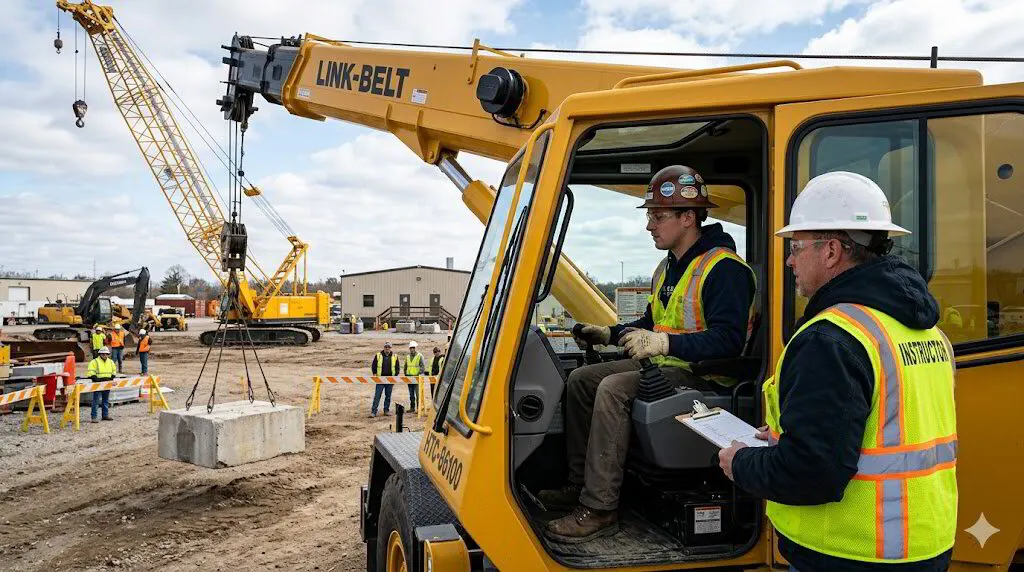
OSHA's crane rule for construction changed the picture. Under 29 CFR 1926.1427, operators must be certified by an accredited testing organization (or qualified through an audited employer program) and then evaluated by their employer on the equipment they will run. An operator in training can still work the crane, but only under the conditions the rule sets, with a qualified trainer monitoring.
Certification exams test theory as well as skill. The written exams cover load charts, site conditions, operations and regulations, and plenty of experienced hands find the chart calculations harder than the driving.
What a classroom does better
- Load charts done properly, every time. Working through gross capacity, deductions and radius on paper builds a method, not a guess.
- The why behind the rules. Knowing why outriggers must be fully extended for a given chart, or why power line distances depend on voltage, makes the rule stick.
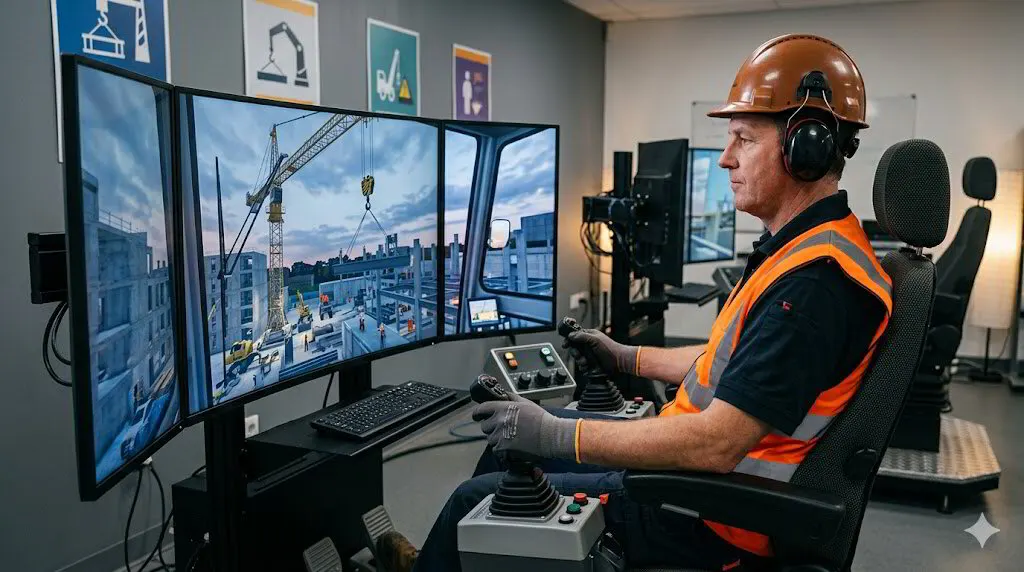
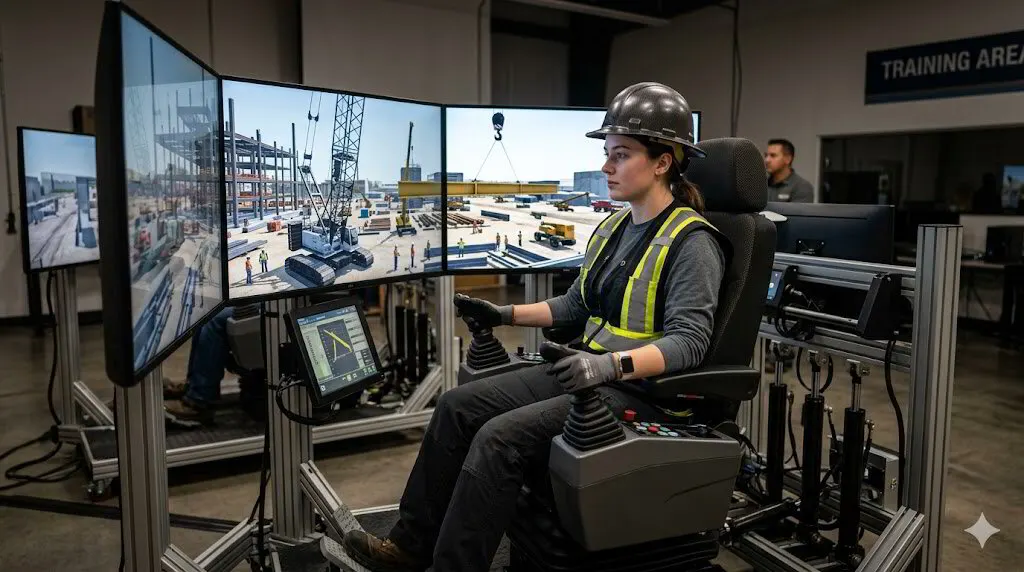
- Mistakes without consequences. A simulator lets you two-block or swing too fast without hurting anyone, and an instructor can stop a yard drill the moment something goes wrong.
- A consistent standard. Every student is taught the same inspection routine and signals, based on ASME B30.5 and Subpart CC.
What only the field can teach
Training yards are controlled on purpose. Real jobs bring mud, tight access, a schedule, crews you have never worked with and loads with unknown weights. Learning to say no to an unsafe pick when the foreman is impatient is a field skill. So is reading a site plan and judging where a crane can actually set up.
That is why the employer evaluation in the OSHA rule exists. Certification shows you know the material and can operate to a standard; the employer confirms you can do this crane, on this job.
Putting the two together
The strongest operators combine both. If you're coming from the field with years around cranes, structured training tightens your theory and prepares you for the written and practical exams. If you are brand new, training gives you a safe starting point, and the field adds judgment over the following years.
A practical approach:
- Get certified for the crane type you will run most.
- Ask for a mentor during your first months on the job, and keep asking questions.
- Keep a notebook of lifts that went wrong or nearly did, and why.
- Add certifications as your work changes, rather than all at once.
Where our courses fit
At our Seagoville site, students split time between classroom, simulator and a yard with telescopic, lattice boom and tower cranes. Experienced operators often choose the Mobile Crane Operations Fixed/Swing Cab 40 Hours or Mobile Crane Operations Lattice 20 Hours course to formalize what they know. Newcomers usually need the longer Mobile Crane Operations Fixed/Swing Cab 120 Hours course for enough seat time.
Questions about training and field experience
I have years of experience but no certification. Do I need a full course?
Not always. Experienced operators often take a shorter course focused on exam preparation. Call us and describe your experience so we can suggest the right length.
Can I operate a crane while I am still in training?
OSHA allows operators in training to operate under specific conditions in 1926.1427, including monitoring by a qualified trainer. Your employer has to set that up.
Does certification mean my employer won't evaluate me?
No. The OSHA rule requires the employer to evaluate a certified operator on the equipment and tasks before assigning work.