
If you have never sat in a crane, the terms and rules can feel like a foreign language. This guide covers the basics a new student should know before the first day of class.
How a crane stays upright
A mobile crane works like a seesaw. The load hangs on one side of a tipping line; the crane's weight and counterweight sit on the other. As long as the counterweight side wins, the crane stays on the ground. Move the load farther out, and it pulls harder against the crane even though it weighs the same.
That is why radius, the horizontal distance from the center of rotation to the load, matters as much as weight. A crane that can lift a heavy load close in may only manage a fraction of that at full radius. On most cranes, at longer radii the limit is tipping; close in, it is often the strength of the boom or other parts. The load chart tells you which applies.
Words you'll hear on day one
- Boom: the arm that holds the load. Telescopic booms slide in and out; lattice booms are steel truss sections pinned together.
- Jib: an extension attached to the boom tip for extra reach.
- Outriggers: beams and floats that extend from the carrier to widen the base and take weight off the tires.
- Hoist line and block: the wire rope and hook assembly that raise and lower the load.
- Parts of line: how many times the rope is reeved between boom tip and block. More parts lift more but move slower.
- Load chart: the manufacturer's table of what the crane may lift in each configuration.
- Swing: rotating the upper works. Luffing: raising or lowering the boom.
Choosing a first crane type
Most beginners start on telescopic mobile cranes, because they are common on construction and industrial jobs. Fixed cab cranes have the operator's cab on the carrier and are often smaller; swing cab cranes have the cab on the rotating upper. Lattice boom crawlers and tower cranes are usually a second step, though some students go straight to tower crane training if they plan to work on buildings.
What you need before training
NCCCO requires candidates to be at least 18 years old, to meet its medical requirements (based on the physical standards in ASME B30.5), and to follow its substance abuse policy. Employers often add their own drug testing. You will also need to read and work through load chart math, so brush up on basic arithmetic and percentages if it has been a while.
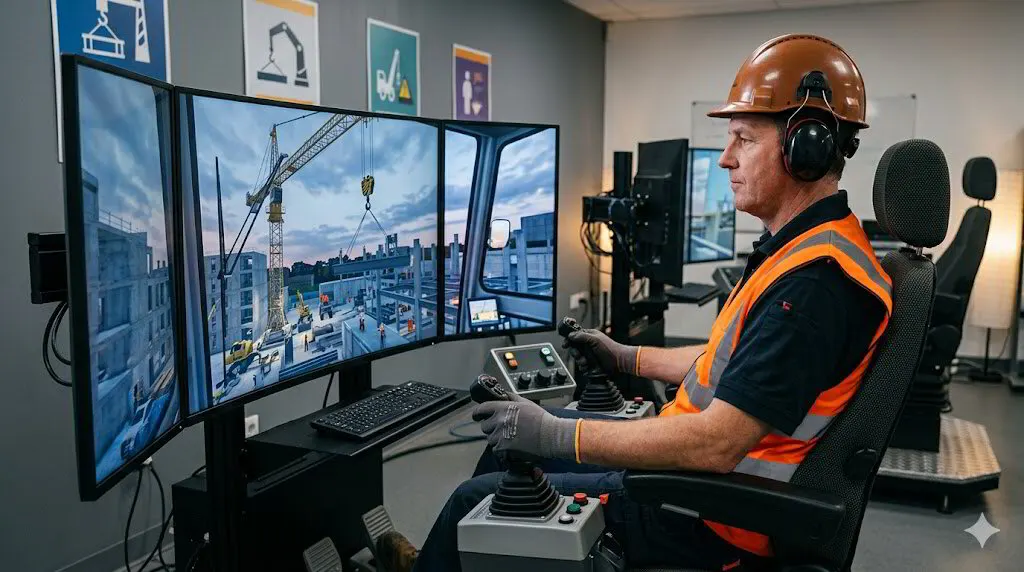
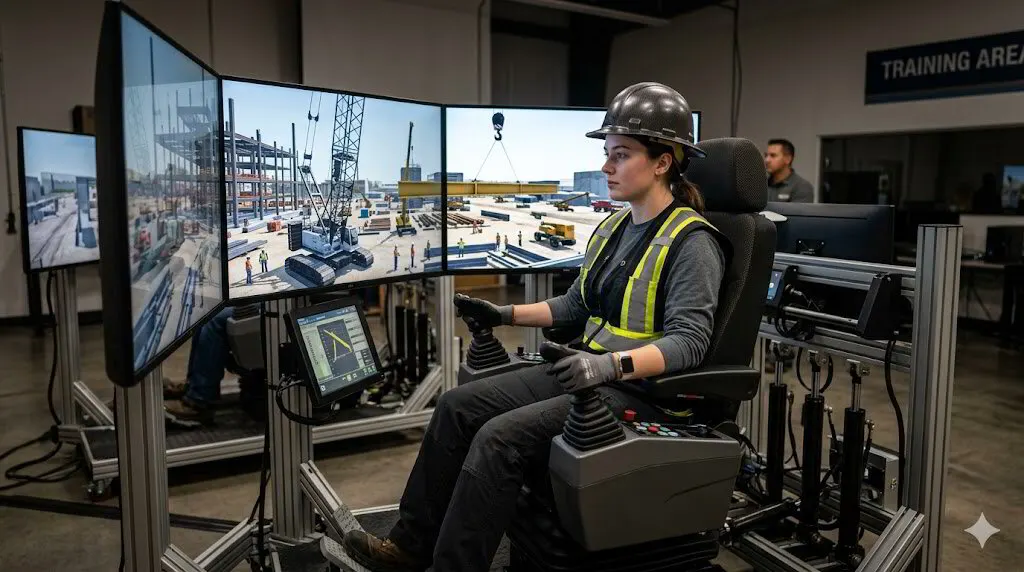
Many beginners worry about heights or about controlling a large machine. Both are normal. Training starts slow, on a simulator, with an instructor beside you.
Your first weeks in the seat
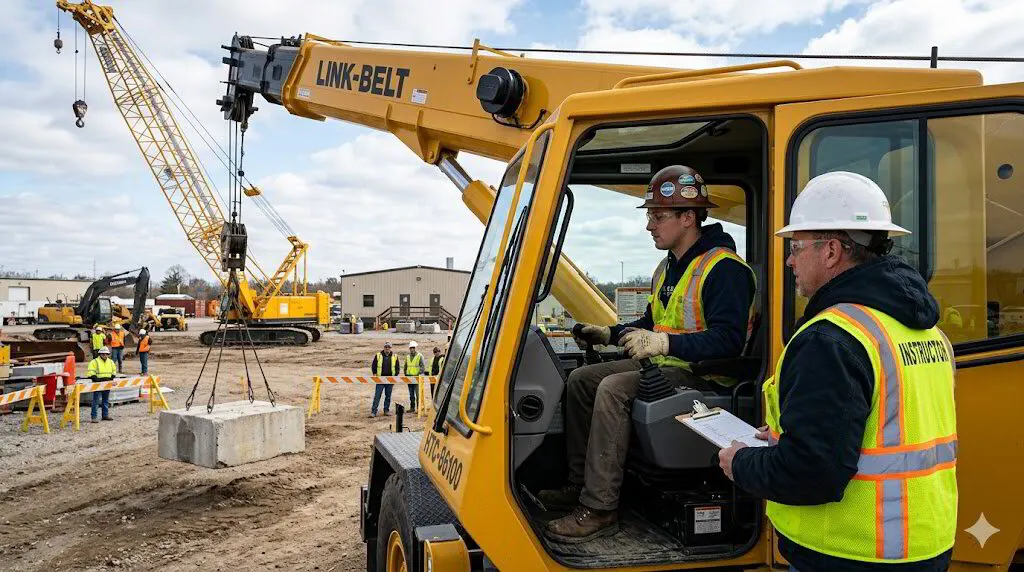
Early lessons focus on smooth control: lifting a test weight a few inches, stopping, and setting it back down without bouncing. Then you add swing, then booming, then combining motions. Most beginners find that the hardest part is not any single control but moving two at once while watching the load and the signal person.
Expect to feel slow at first. Smooth beats fast, and speed comes on its own.
Outside the cab, you will also spend time on the ground. Beginners learn to hook up the test weight, inspect slings and give hand signals to classmates. Seeing the lift from the signal person's position makes you a better operator, because you understand what the person on the ground can and cannot see.
Keep a notebook. Write down each new term, each load chart problem you got wrong and why, and anything an instructor corrected twice. Reviewing it for ten minutes each evening is one of the simplest ways to make the lessons stick.
Where to start with us
For students with no crane experience, the Mobile Crane Operations Fixed/Swing Cab 120 Hours course in Seagoville provides the classroom time and seat time a beginner needs to prepare for NCCCO exams. Students who travel from far away can choose the Premium Plus Mobile Crane Operations Fixed/Swing Cab Course, which offers optional room and board. The admission page explains how to enroll.
Beginner questions
Do I need any experience before enrolling as a beginner?
No. Our 120-hour fixed/swing cab course is designed for students with little or no crane time.
How old do I have to be to get NCCCO certified?
NCCCO requires candidates to be at least 18.
Why does the crane lift less when the boom is lowered?
Lowering the boom increases the radius, so the load pulls harder against the crane. Capacity drops as radius grows.