
NCCCO mobile crane certification has a fixed sequence, and knowing it ahead of time keeps you from paying for exams in the wrong order or letting a deadline slip. This walk-through follows the order most of our students go through it.
Step 1: Pick the crane type and check eligibility
NCCCO does not certify you for "mobile cranes" in general. You earn one or more specialty designations, and the right one depends on the machines in your future employer's fleet:
| Specialty | Typical machines |
|---|---|
| Telescopic, swing cab (TLL) | Rough-terrain and all-terrain hydraulic cranes |
| Telescopic, fixed cab (TSS) | Smaller hydraulic cranes with a cab that stays put while the upper rotates |
| Lattice boom | Crawler cranes and truck-mounted lattice cranes |
Many new operators test for both telescopic specialties at once, since the written content overlaps and the extra designation widens the list of cranes they can be hired to run.
Before you register, confirm the basics: candidates must be at least 18, agree to NCCCO's code of ethics and substance abuse policy, and meet the physical expectations in ASME B30.5. No prior seat hours are required to sit for the exams, but the practical is hard to pass without real time on a crane, which is why most people take a course instead of testing cold.
Step 2: Pass the written Core exam
Every mobile crane candidate takes the same Core exam: 90 multiple-choice questions in 90 minutes, according to NCCCO's mobile crane page. It covers site setup, operations, technical knowledge such as load dynamics, and the OSHA and ASME rules that apply to every crane type. Expect questions on power line clearance, ground conditions, inspections and signals.
Step 3: Pass a written Specialty exam with the load chart
Each Specialty exam is 26 questions in 60 minutes, and most of it is load chart work. You get a chart for a real crane and have to find gross capacity at a given radius and boom length, subtract the hook block and rigging, and decide whether the lift is allowed. People who know cranes but have never worked a chart under time pressure often find this the hardest part of the whole process.
Core and specialty can be taken on the same day. You must pass the Core and at least one Specialty to move on.
Step 4: Pass the practical in the matching crane
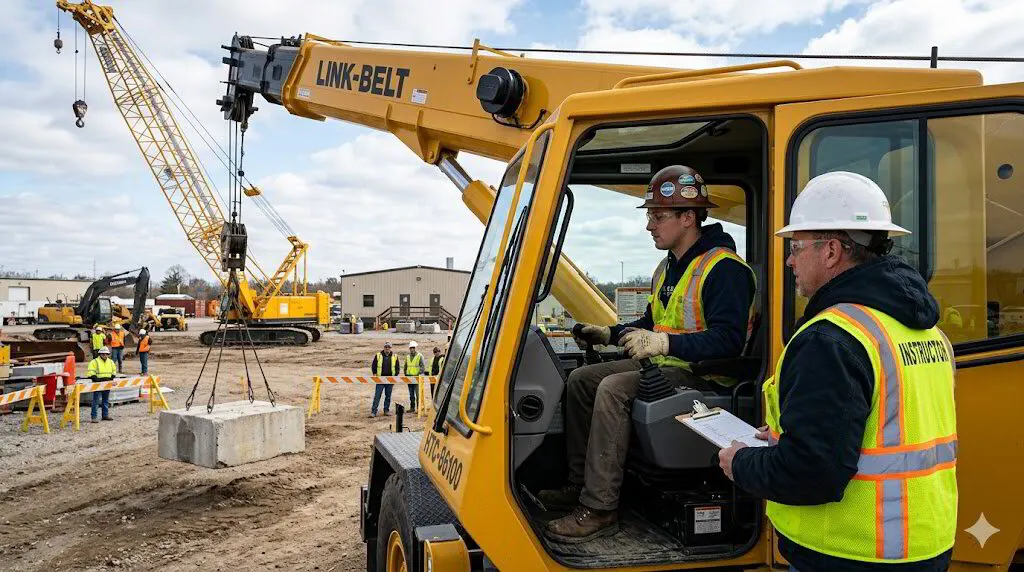
The practical exam is done in a crane of the same type as your specialty, on a measured course, with an examiner watching. You hoist, boom and swing a test weight through set zones, place it in target circles without touching the poles, and follow hand signals, all against a time limit and with penalties for contact or rough control.
NCCCO requires you to pass the practical within 12 months of passing the written exams. Plan your course dates so the two fall close together.
Practical day tends to be more stressful than the written exams for first-time candidates. Familiarity helps: knowing the crane, the course layout and the examiner's instructions before you climb into the cab takes a lot of that pressure away.
Step 5: Keep it current
NCCCO certification lasts five years. Recertification has its own written and experience requirements, so check NCCCO's current candidate handbook a year or so before your card expires. Your employer will also evaluate you on each crane before you run it, as 29 CFR 1926.1427 requires; certification does not replace that.
Where our courses fit in this sequence
Miller Crane Works is a CCO EDU Accredited Training Provider, and the practical exam site is in the same Seagoville yard where you train. New operators usually take Mobile Crane Operations Fixed/Swing Cab 120 Hours, which covers steps 3 through 5 with enough seat time to learn the crane, not just the test. If you already operate and only need exam preparation, Mobile Crane Operations Fixed/Swing Cab 40 Hours is shorter. Lattice candidates look at Mobile Crane Operations Lattice 40 Hours.
Mobile crane certification questions
Can I take the TLL and TSS specialty exams on the same day?
Yes. Many candidates take the Core plus both telescopic specialties in one sitting, then complete a practical for each designation they want.
What happens if I pass the written exams but not the practical?
You can retest on the practical, as long as you pass within 12 months of the written exam. If that window closes, plan on taking the written exams again; NCCCO's candidate handbook has the current retest rules.
Does a TLL certification let me run a lattice crawler?
No. Lattice boom cranes are a separate specialty with their own written and practical exams.