
Passing the NCCCO exams proves you can run a crane on a test course. The first year on real jobs teaches the rest. Below are habits good operators tend to pick up early, and the ones we try to start in class.
Walk the site before you touch the controls
Seasoned operators get out of the truck and look around before they set up. Where is the soft ground from last night's rain? Is there a buried utility, a culvert or a backfilled trench under where the outrigger pad will land? Where are the power lines, and which way will the boom swing toward them? OSHA puts specific duties on the controlling contractor for ground conditions (1926.1402), but the operator is the one who feels it first if a pad starts to sink.
A two-minute walk also shows you where people will stand, where the load is coming from and where it is going, so the lift plan stops being a drawing.
Treat the load chart as yours, not the foreman's
On the exam, you work a chart because you have to. On the job, it is easy to let someone else hand you a weight and a radius and trust both. Good operators check. They ask how the load weight was determined, measure or estimate radius themselves, include every deduction, and look again if the configuration changes partway through the day. If the numbers are tight, they say so before the load leaves the ground.
It also pays to know the crane in front of you, not just cranes in general. Read the operator's manual for any model you have not run before, look at where its chart changes between configurations, and find the quirks: a swing that coasts, a slow telescope, an indicator that needs a particular setup sequence.
Agree on signals before the first pick
A quick conversation with the signal person saves trouble later. Settle which method you will use (hand, voice or both), what the stop signal looks like, what happens if a radio cuts out, and who is the only person you take signals from. The one exception everyone knows: an emergency stop from anyone on site gets obeyed, every time.
New operators sometimes feel awkward asking for this. Experienced ones never skip it.
Do the shift inspection like it matters
OSHA requires a visual inspection each shift by a competent person (1926.1412). Operators who have been around a while do it in the same order every day: wire rope, hook and latch, sheaves, boom sections, outriggers and pads, fluid leaks, safety devices such as the anti-two-block and load moment indicator. A fixed routine is how you notice the one thing that looks different from yesterday.
Know when to stop the job
Gusting wind, a load that comes up heavier than expected, a signal you did not understand, someone walking under the load: each one is a reason to stop and sort it out. Certified operators have the authority to refuse an unsafe lift, and the ones with long careers use it. Nobody remembers the ten minutes lost to a pause. People remember the lift that went wrong.
Logging your hours and the cranes you run helps too. That record makes later certifications and job applications easier.
Starting these habits in training
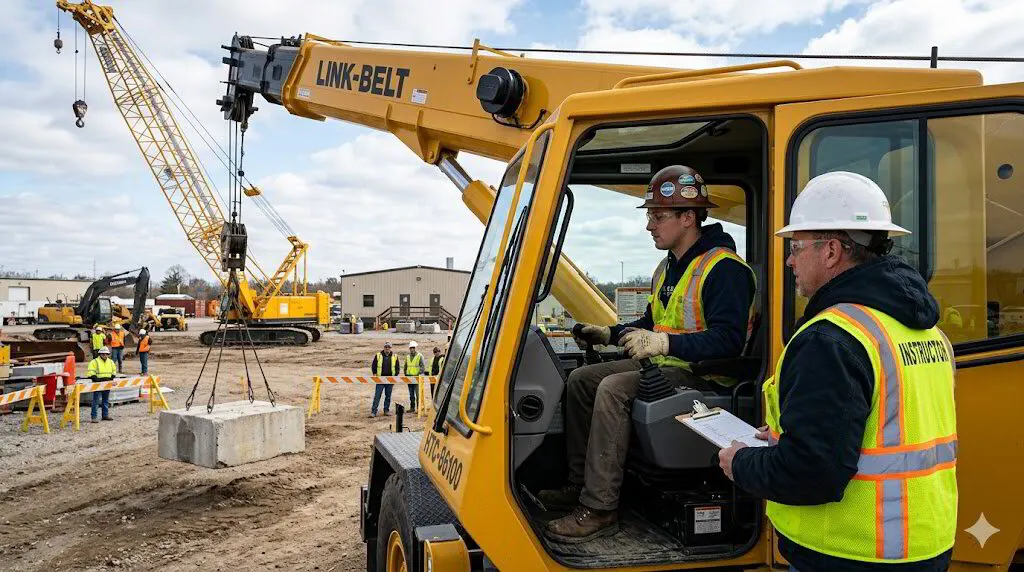
Our courses build these habits from the first week. Students do pre-use inspections on the yard cranes, work load charts with an instructor, and practice taking signals on the same course used for the NCCCO practical exam in Seagoville. For people new to cranes, Mobile Crane Operations Fixed/Swing Cab 120 Hours gives the most time to practice them. Crew members who will be on the ground side of the signals can take Rigger/Signal Person Certification Level I 28 Hours.
Questions about the first year after certification
Will my first employer let me run cranes right after I certify?
That depends on the employer. OSHA requires them to evaluate you on the specific crane first, and many start new operators on smaller cranes or simpler picks while they build experience.
Can a crane operator refuse a lift?
Yes. Under 29 CFR 1926.1418, whenever there is a safety concern the operator has the authority to stop and refuse to handle loads until a qualified person has determined that safety has been assured.
Why keep a log of my crane hours?
A record of hours and crane types helps when you apply for jobs, add a certification or recertify, because you can show what you have actually run.