Running a tower crane is a different job from running a mobile crane. You sit high above the work, you often can't see the hook, and you depend on a radio voice below. Here is what good tower crane training has to cover, and how ours is set up in Seagoville.
How a tower crane differs from a mobile crane
A mobile crane operator sets up a machine, levels it on outriggers or tracks, and reads a chart built around boom length and radius. A tower crane is erected once and stays put for months. The mast is anchored to a foundation or tied into the building, and the operator works the same footprint every day.
The motions change too. On a hammerhead or flat-top crane the load moves in and out on a trolley that runs along the jib, the whole upper structure slews on a slewing ring, and the hoist raises and lowers. A luffing jib crane changes radius by raising and lowering the jib instead. Each design has its own feel, and capacity drops as the trolley moves out, so the chart you check most is the one that ties load weight to trolley radius.
What the classroom has to teach
Tower crane theory is short on fluff and long on things that hurt people when they are misunderstood. Expect to spend real time on:
- Load charts. Reading capacity at a given radius, accounting for the hook block and rigging weight, and knowing why the chart for one jib length does not apply to another.
- Limit devices. Load moment limits, maximum load limits, trolley and hoist limits, and slewing limits. You learn what each one does and why a limit is a backstop, not a way to operate.
- Wind. Tower cranes catch wind across a long jib. Operators learn the manufacturer's in-service wind limit, how a big flat load such as a wall form acts like a sail, and why the crane is left free to weathervane when it is out of service.
- The rules. OSHA 29 CFR 1926 Subpart CC, including the tower crane section (1926.1435), and the ASME B30.3 standard for tower cranes.
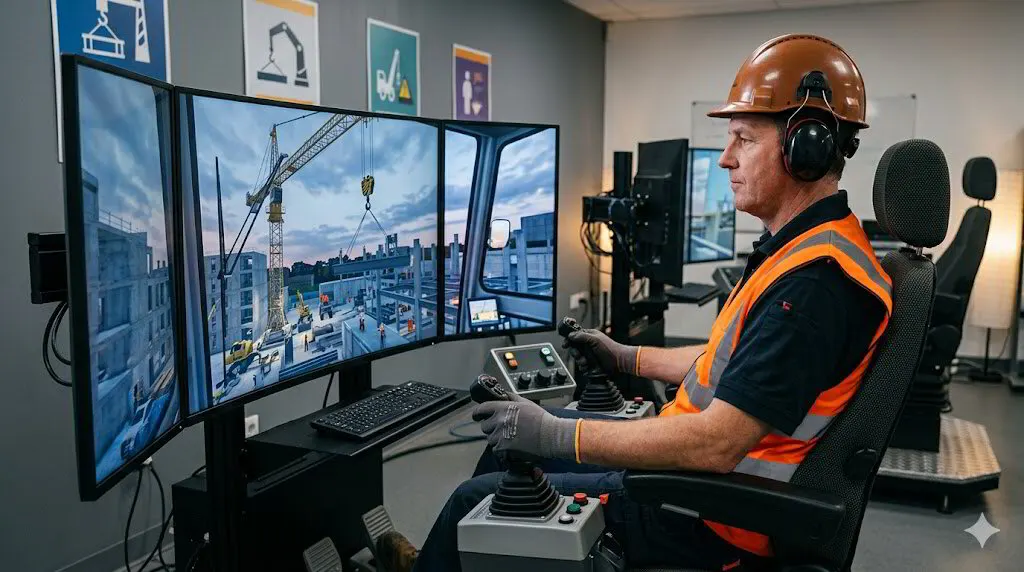
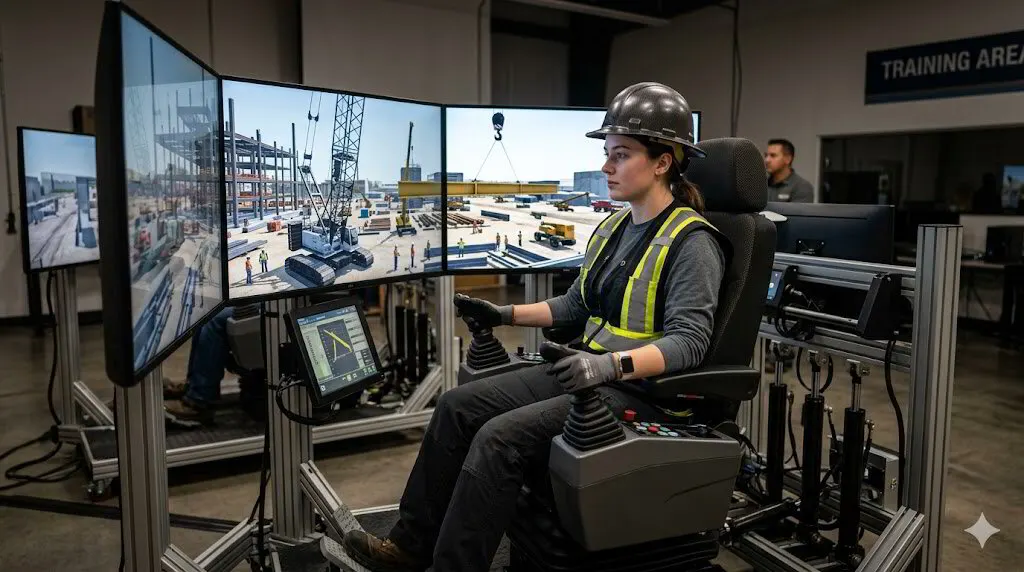
A crane simulator is part of our classroom, so students practice slewing and trolley control before they climb the mast.
Working blind on a radio
On a high-rise job the operator often lifts from a laydown area they can barely see and lands the load on a deck they can't see at all. Everything depends on clear communication with a signal person. Good training drills that relationship: standard hand signals from OSHA's Subpart CC appendix, voice commands over a dedicated radio channel, and the rule that the operator stops when a signal is unclear or the radio goes quiet. Operators also learn to obey a stop signal from anyone on site.
This is why many tower crane students also take rigging and signaling training. Knowing what the person on the ground is looking at makes you a calmer operator in the cab.
Seat time in the yard and the NCCCO exams
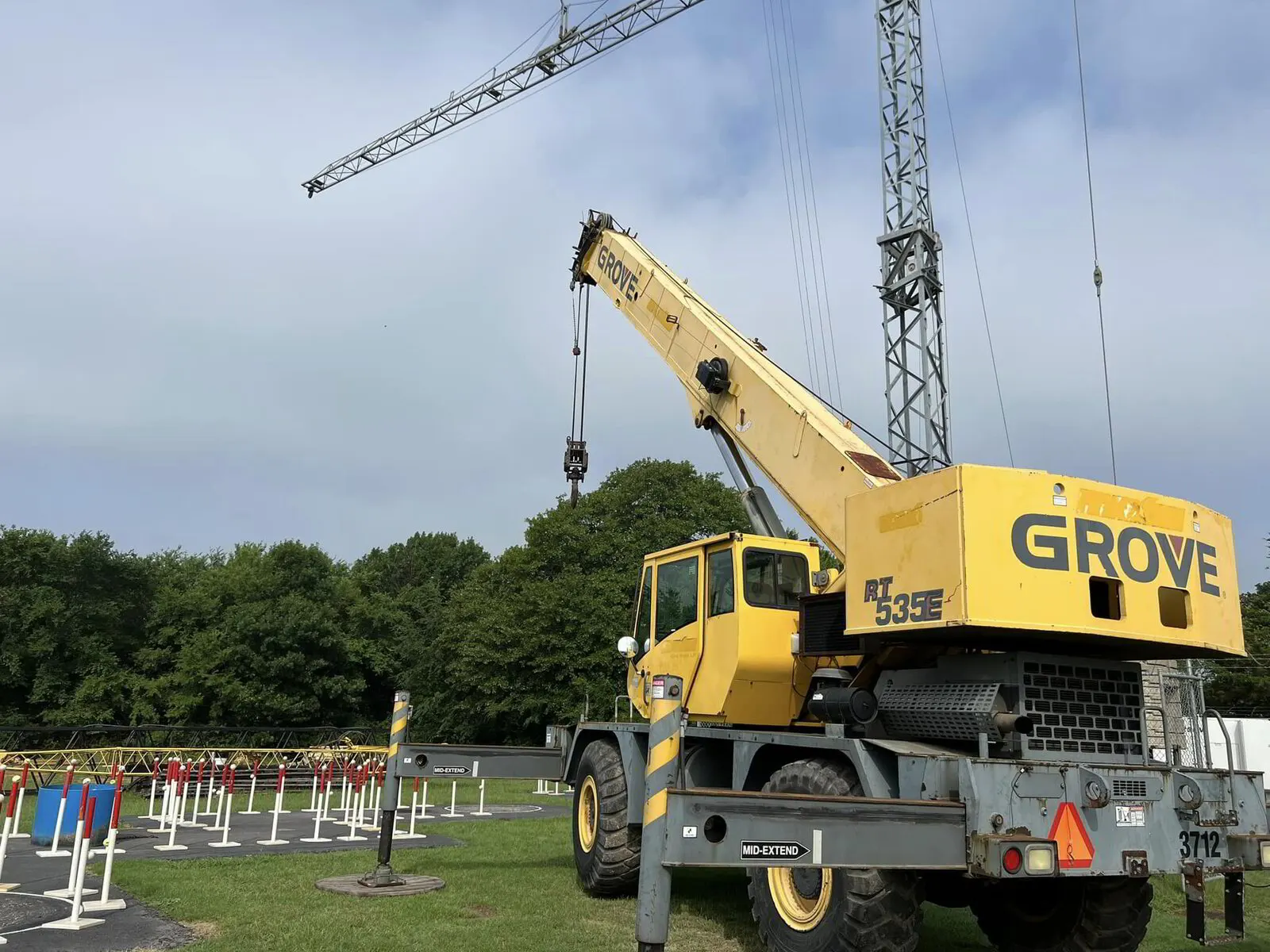
Our training yard has a tower crane, so seat time happens on a real machine, not only on a screen. Students start with smooth starts and stops on each motion, then combine slewing and trolley moves while keeping the load from swinging. Later sessions focus on precise placement, the kind of control the practical exam asks for.
NCCCO tower crane certification has two parts: a written exam and a practical exam operating a tower crane. NCCCO requires both to be passed within a 12-month window. Because we are a CCO EDU Accredited Training Provider and the tower crane practical exam is given in our own yard, you train where you will test. NCCCO grades the exams and issues the certification; our part is preparing you for them.
Which tower crane course fits you
If you have never run a tower crane, start with Tower Crane Operations 40 Hours. It gives enough classroom and seat time to build the basics. Operators who already run tower cranes and need exam preparation often take Tower Crane Operations 20 Hours. Students traveling in from outside the Dallas area can look at the Premium Tower Crane Operations 48 Course, which offers optional room and board while you train. Funding options, including GI Bill® benefits, are on the funding page.
Tower crane training questions
Do I need mobile crane experience before tower crane training?
No. Tower crane certification is its own NCCCO program. Mobile crane experience helps with load chart thinking, but our 40-hour tower course is built for people new to tower cranes.
Is the NCCCO tower crane practical exam held at your yard?
Yes. Our Seagoville yard is an NCCCO practical exam site with a tower crane, so you can test on the course where you trained. NCCCO administers and scores the exam.
Why are tower cranes left free to slew when out of service?
Letting the upper structure weathervane allows the jib to turn with the wind instead of fighting it. Follow the manufacturer's out-of-service procedure for the specific crane.