The operator gets the attention, but most of the decisions that make a lift safe happen on the ground. Following a single pick from start to finish is the clearest way to see what riggers and signal persons actually do.
Before the load moves: the rigger's homework
A rigger's work starts with information. What does the load weigh, and how was that number found: a nameplate, shipping papers, a calculation? Where is its center of gravity? Are there lifting lugs, and are they rated for the angle they will be loaded at? Is the load fragile, flexible or likely to shift?
With those answers, the rigger picks the hitch (vertical, choker or basket), the sling type and length, and the hardware. Sling angle is a big part of that choice. As the angle between the sling legs and the load gets flatter, the tension in each leg climbs, so a sling that is fine hanging straight can be overloaded at a shallow angle.
Inspecting and attaching
Every sling, shackle and hook gets a look before use: tags legible, no cuts, crushing or broken wires, no heat damage, no stretched or cracked hardware. Damaged gear is removed from service, not set aside for later.
Then the rigger attaches the load so the hook ends up directly over the center of gravity. Softeners protect slings from sharp edges. Tag lines go on loads that might spin, so the crew can control them without anyone standing underneath. Before the lift, the rigger makes sure everyone not needed is out of the fall zone.
The test lift
On the signal, the operator takes up slack and lifts the load just clear of the ground. The crew watches for three things: whether the load hangs level, whether the rigging is seated properly, and whether the crane and its supports are behaving as expected. If the load tilts, the rigging gets adjusted now, a few inches up, rather than halfway to the landing point. A good rigger is never embarrassed to set a load back down.
The signal person takes over
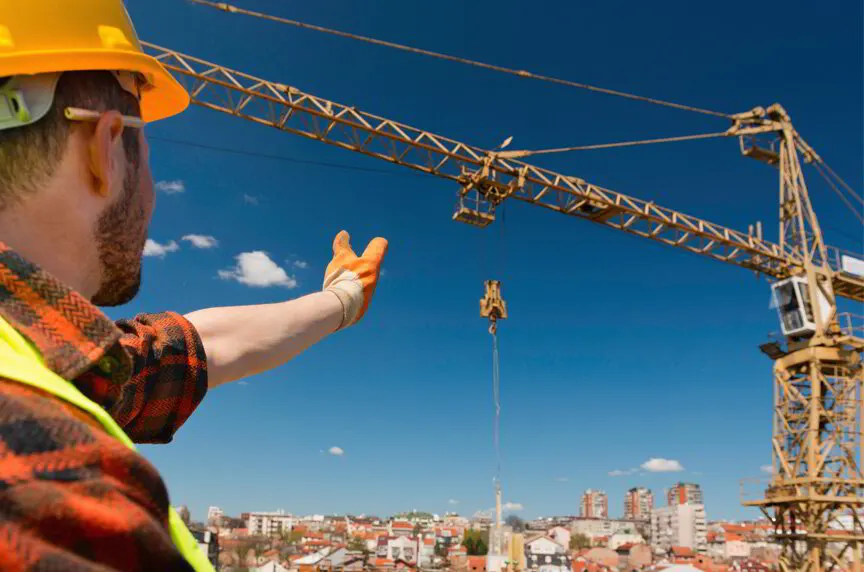
Once the load is moving, the signal person becomes the link between the operator and what is happening around the load. OSHA requires a signal person when the operator cannot see the point of operation or the load path, or when the operator or the person handling the load decides one is needed for safety (1926.1419).
Hand signals
Hand signals must follow the standard method shown in Appendix A of Subpart CC, unless that is not feasible. The signal person stays in clear view of the operator, uses one set of signals consistently, and is the only one giving them.
Voice and radio signals
Before voice signals are used, the operator, signal person and lift director (if there is one) agree on them. Each voice signal names the function and direction, then the distance or speed, then the stop, in that order. Radios need a dedicated channel so other site chatter does not interrupt the lift.
Landing and unhooking
The last few feet are where loads get damaged and hands get pinched. The signal person slows the operator down, the crew uses tag lines rather than hands on the load, and blocking or dunnage is in place before the load touches. The rigger confirms the load is stable and supported before anyone slacks the rigging. Only then do slings come off, and the hook goes up clear of people and obstacles.
Training for the ground crew
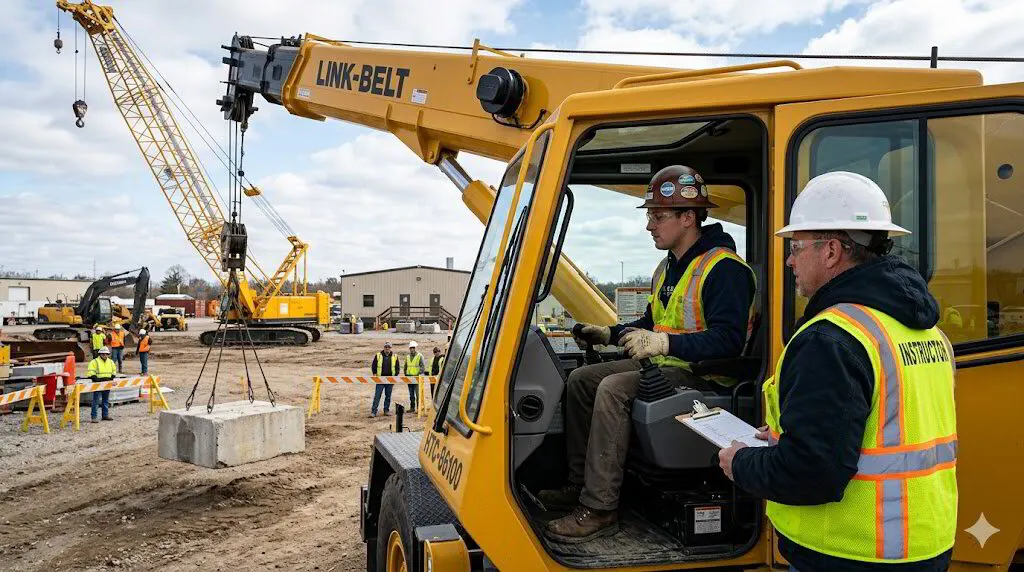
Riggers and signal persons need to be qualified under OSHA's crane rule, and many sites want third-party proof. Our Rigger/Signal Person Certification Level I 28 Hours course prepares students for NCCCO Rigger Level I and Signalperson, with hands-on rigging and live signaling to cranes in our Seagoville yard. For a shorter course that covers the basics for a crew, there is the Miller Crane Works Level I Rigger/Signal Person 4 Hours qualification. Employers sending a group can use company classes.
Rigger and signal person questions
Who is allowed to give the stop signal?
Normally only the designated signal person directs the operator, but an emergency stop signal from anyone must be obeyed.
Why do sling angles matter so much?
The flatter the sling angle, the more tension each leg carries. A sling rated for the load in a vertical hitch can be overloaded at a shallow angle.
Can the signal person also handle the tag line?
Their first job is signaling, and they need to stay visible to the operator. On most lifts, someone else handles the tag line so the signal person is not distracted.