
Most crane mistakes are not exotic. They come from shortcuts that worked fine the last twenty times. Here are the ones we correct most often, and what to do instead.
Load chart mistakes
1. Reading the wrong column
Charts list capacities by boom length, radius and configuration: outriggers fully extended, mid-extended or on rubber, over the rear or over the side, 360 degrees. Picking a number from the wrong chart can overstate capacity badly. Fix: say the configuration out loud before you look up the number.
2. Forgetting deductions
The gross capacity in the chart includes everything hanging below the boom tip. The hook block, slings, shackles, spreader bar and an erected or stowed jib all come off before you get to what the load can weigh. Fix: write the deductions as a list every time, even on simple picks.
3. Planning the pick radius but not the set radius
The load often lands farther out than it starts. Fix: use the longest radius in the lift path to check capacity.
Setup mistakes
4. Trusting the ground
Pads that are too small, recent backfill, or an outrigger over a buried pipe can let the crane settle mid-lift. Fix: ask what is under the setup area, use mats sized to spread the load, and watch the outriggers on the first pick.
5. Being slightly out of level
A crane that is not level side loads the boom as it swings, which the chart does not assume. Fix: level with the bubble before every lift session and recheck after the ground has had time to settle.
Operating mistakes
6. Side loading and dragging
Booms are built to carry loads hanging straight down. Pulling a load sideways, or dragging it across the ground with the hoist, puts forces on the boom it was not designed for. Fix: position the boom tip directly over the load before lifting. If the load has to move horizontally first, re-rig or reposition.
7. Two-blocking
Hoisting until the hook block contacts the boom tip can part the rope and drop the load. It happens most when telescoping out or lowering the boom without paying out hoist line. Fix: watch the block while you boom, and never bypass the anti-two-block system.
Communication mistakes
8. Following signals from anyone
On a busy site three people may wave at you. Only the designated signal person gives movement signals; anyone may give a stop. Fix: agree on who signals and how before the lift, and if you lose sight of the signal person or the radio goes quiet, stop.
A ninth mistake belongs to the whole crew: assuming someone else checked. The operator assumes the rigger weighed the load; the rigger assumes the operator checked the chart. A thirty-second huddle before a lift catches most of these gaps.
Fatigue makes all of these worse. Late in a long shift, operators skip the deduction list, accept a sloppy setup and stop scanning for people in the swing radius. If you notice yourself rushing, that is the moment to slow down, not speed up.
Catching mistakes before they become habits
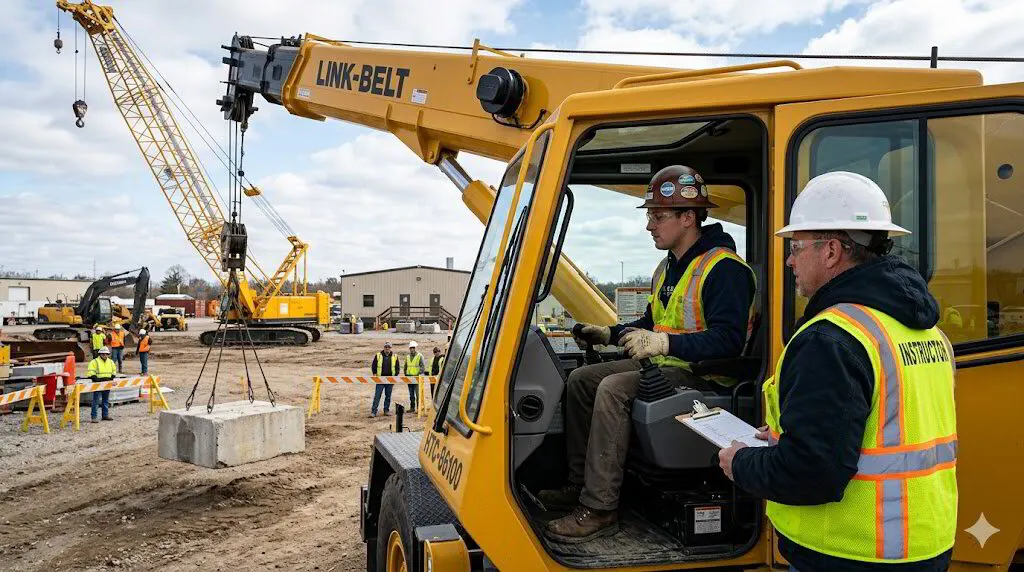
The best time to fix a bad habit is before it forms. In our Seagoville yard, instructors watch every move and stop the drill when something is off, which is hard to get on a production job. Students work load chart problems with deductions in the classroom, then use those numbers on the crane the same afternoon.
New operators usually take the Mobile Crane Operations Fixed/Swing Cab 120 Hours course. Operators who have some seat time and want to clean up technique before the NCCCO exams often take the Mobile Crane Operations Fixed/Swing Cab 40 Hours course. For extra seat time, ask about the practice questions.
Questions about avoiding crane mistakes
What is the most common load chart error?
Leaving out deductions. The chart capacity covers everything below the boom tip, so the hook block, rigging and any jib must be subtracted before you know what the load itself can weigh.
What does two-blocking mean?
The hook block or headache ball being pulled into the boom tip sheaves. It can break the hoist rope and drop the load, which is why anti-two-block devices are required.
Is it ever okay to drag a load with a crane?
No. Dragging side loads the boom. Move the crane or re-rig so the hoist line is plumb over the load's center of gravity.