
Introduction
The construction industry in Texas continues to experience unprecedented growth, with towering skyscrapers, expansive infrastructure projects, and industrial developments reshaping the state's landscape. At the heart of these massive undertakings are skilled crane operators who safely maneuver heavy equipment to lift, move, and position materials with precision and expertise. Understanding how to become a certified crane operator in Texas is essential for anyone seeking to enter this rewarding and stable career field.
Crane operator certification represents far more than a simple credential—it serves as a testament to your professional competency, safety awareness, and technical proficiency. The National Commission for the Certification of Crane Operators (NCCCO) sets the gold standard for certification nationwide, ensuring that operators possess the knowledge and skills necessary to perform their duties safely and effectively.
Modern crane operation roles encompass various specializations, from mobile crane operators working on construction sites to tower crane operators managing high-rise projects. Each position requires specific training, certification, and ongoing education to maintain compliance with Texas crane safety regulations. Whether you're an aspiring professional entering the construction industry or an experienced worker seeking career advancement, proper certification opens doors to higher-paying positions and enhanced job security in Texas's thriving construction sector.
Understanding the Certification Process
NCCCO certification Texas represents the most widely recognized and respected credential for crane operators throughout the United States. The National Commission for the Certification of Crane Operators established comprehensive standards that ensure operators demonstrate both theoretical knowledge and practical competency in their chosen crane specialty. This certification system provides employers with confidence that certified operators can safely handle complex lifting operations while minimizing workplace accidents and equipment damage.
The benefits of becoming certified extend far beyond meeting regulatory requirements. Certified crane operators typically earn significantly higher wages compared to their non-certified counterparts, with salary increases ranging from 15% to 30% depending on experience and specialization. Certification also enhances job mobility, allowing operators to work across state lines and pursue opportunities with major construction companies that require NCCCO credentials for employment.
Several types of crane operator certifications are available through NCCCO, each tailored to specific equipment categories and operational environments. Mobile crane operator certification covers hydraulic cranes commonly used in construction and industrial applications. Tower crane certification focuses on the fixed cranes essential for high-rise construction projects. Lattice boom crawler crane certification addresses the specialized equipment used in heavy industrial and infrastructure projects.
The crane certification process involves both written examinations and practical assessments. Written exams test candidates' understanding of load charts, rigging principles, safety protocols, and equipment specifications. Practical evaluations assess hands-on operational skills, including pre-operational inspections, load handling techniques, and emergency procedures. This comprehensive approach ensures that certified operators possess the complete skill set necessary for safe and effective crane operation in Texas's demanding construction environment.
Eligibility Requirements for Certification in Texas
Before pursuing NCCCO certification, candidates must meet specific eligibility requirements that ensure they possess the foundational knowledge and maturity necessary for safe crane operation. The minimum age requirement for crane operator certification is 18 years, reflecting the serious responsibility and potential hazards associated with operating heavy lifting equipment. While formal education requirements are minimal, candidates must demonstrate basic literacy and mathematical skills sufficient to interpret load charts, calculate capacities, and understand technical documentation.
Prerequisite experience varies depending on the certification type and individual circumstances. Many candidates benefit from completing formal crane operator training programs before attempting certification exams, as these courses provide structured learning environments and hands-on practice opportunities. Some certification categories require documented operational experience, typically ranging from 1,000 to 2,000 hours of verified crane operation under qualified supervision. This experience requirement ensures that candidates have sufficient exposure to real-world operational challenges and safety considerations.
The NCCCO application process begins with completing the appropriate application forms and submitting required documentation. Candidates must provide proof of identity, age verification, and any relevant experience documentation. Medical certification may be required for certain positions, particularly those involving tower crane operation or work in specialized industrial environments. The application process also includes background checks to ensure candidates meet safety and reliability standards expected in the construction industry.
Texas crane safety regulations align with federal OSHA standards while incorporating state-specific requirements for certain types of operations. Candidates should familiarize themselves with both federal and state regulations governing crane operations, as this knowledge forms a crucial component of certification examinations. Understanding regulatory requirements also helps operators maintain compliance throughout their careers and avoid violations that could impact their certification status or employment opportunities.
Choosing a Training Provider
Selecting the right training provider represents a critical decision that directly impacts your success in achieving certification and building a successful crane operation career. Several key factors should guide your evaluation of potential training providers, ensuring you receive comprehensive, high-quality instruction that prepares you for both certification exams and real-world operational challenges.
Accreditation stands as the most important consideration when evaluating training providers. Look for programs that maintain NCCCO accreditation and demonstrate compliance with industry training standards. Accredited programs follow established curricula, employ qualified instructors, and provide standardized training experiences that align with certification requirements. Additionally, consider the provider's track record for certification exam pass rates, as this metric reflects the effectiveness of their training methods and curriculum quality.
Instructor experience and qualifications significantly influence training quality and relevance. Seek providers whose instructors possess extensive operational experience, current certifications, and proven teaching abilities. Experienced instructors can share practical insights, real-world scenarios, and troubleshooting techniques that enhance your understanding beyond textbook knowledge. They also provide valuable networking opportunities and industry connections that can benefit your career development.
Miller Crane Works stands out as a premier training provider offering comprehensive crane operator training programs designed to ensure student success. Our experienced instructors bring decades of operational experience and maintain current certifications across multiple crane specialties. We provide state-of-the-art training equipment, modern facilities, and flexible scheduling options to accommodate working professionals. Our curriculum combines thorough theoretical instruction with extensive hands-on practice, ensuring students develop both the knowledge and skills necessary for certification success.
When comparing training providers, consider factors such as class sizes, equipment availability, training duration, and ongoing support services. Smaller class sizes typically provide more individualized attention and practice opportunities. Access to modern, well-maintained training equipment ensures you gain experience with current industry standards. Comprehensive programs that include both written exam preparation and practical training offer the best value and preparation for certification success.
Types of Crane Operator Training Courses
Training for crane operators encompasses several specialized courses designed to address the unique requirements and operational characteristics of different crane types. Understanding these various training options helps you select the appropriate certification path based on your career goals and the types of projects you plan to work on throughout your crane operation career.
Mobile crane courses focus on hydraulic cranes that provide the backbone of construction and industrial lifting operations. These versatile machines can be quickly deployed to job sites and configured for various lifting tasks. Mobile crane operator training covers load chart interpretation, outrigger setup, boom angle calculations, and safe operating procedures for different ground conditions. Students learn to assess site conditions, plan lifting operations, and execute complex picks while maintaining safety standards. The training also addresses transportation requirements, setup procedures, and maintenance considerations specific to mobile crane operations.
Tower crane courses prepare operators for the specialized requirements of high-rise construction projects. Tower cranes require different operational skills compared to mobile cranes, including understanding of building integration, coordination with other trades, and management of long-duration projects. Training covers assembly and disassembly procedures, load moment systems, anti-collision technologies, and emergency protocols specific to tower crane operations. Students also learn about weather considerations, coordination with construction schedules, and communication procedures essential for effective tower crane operation.
Lattice crane courses address the unique requirements of large crawler cranes used in heavy industrial applications. These powerful machines handle the heaviest lifts in construction and industrial projects, requiring specialized knowledge of boom configurations, counterweight systems, and ground preparation requirements. Training covers load block handling, boom angle optimization, track movement procedures, and coordination with rigging crews for complex lifting operations. Students learn to interpret complex load charts, plan multi-crane lifts, and execute precision placement operations.
Rigger and signal person courses complement crane operator training by addressing the critical support roles essential for safe lifting operations. Rigger certification covers load assessment, rigging hardware selection, sling angle calculations, and load securement techniques. Signal person training focuses on communication protocols, hand signals, radio procedures, and coordination responsibilities. These courses are often pursued simultaneously with crane operator training, as understanding all aspects of lifting operations enhances safety and operational effectiveness.
Preparing for the Certification Exam
Successful certification exam preparation requires a systematic approach that combines comprehensive study materials, practice examinations, and focused review of key topics. The NCCCO certification exams are designed to thoroughly assess both theoretical knowledge and practical understanding of crane operations, safety protocols, and industry regulations.
Study materials should include official NCCCO candidate handbooks, which provide detailed information about exam content, format, and scoring procedures. These handbooks outline specific topics covered in each certification category and provide sample questions that illustrate the exam format and difficulty level. Additionally, crane operator training materials from reputable sources offer in-depth coverage of operational principles, safety procedures, and technical specifications. Load chart interpretation guides are particularly valuable, as load chart questions represent a significant portion of most certification exams.
Practice exams serve as invaluable preparation tools that help familiarize candidates with exam format, timing, and question types. Many training providers offer practice exams that simulate actual certification tests, allowing candidates to identify knowledge gaps and focus their study efforts effectively. Regular practice exam sessions help build confidence and improve time management skills essential for success during actual certification testing. Review incorrect answers thoroughly to understand underlying concepts and avoid similar mistakes during the actual exam.
Common exam topics include load chart interpretation, which requires understanding of capacity ratings, boom angles, and operational limitations. Safety procedures represent another major exam component, covering pre-operational inspections, hazard recognition, and emergency protocols. Equipment specifications and operational characteristics are tested through questions about crane components, control systems, and maintenance requirements. Regulatory knowledge is assessed through questions about OSHA standards, state regulations, and industry best practices.
Effective revision strategies include creating study schedules that allow adequate time for comprehensive review, forming study groups with other candidates to discuss challenging concepts, and seeking clarification from instructors about complex topics. Focus on understanding underlying principles rather than memorizing specific information, as exam questions often require application of knowledge to new scenarios rather than simple recall of facts.
Hands-on Practical Training
Practical training represents the cornerstone of effective crane operator education, providing essential hands-on experience that bridges the gap between theoretical knowledge and real-world operational competency. While written examinations assess understanding of principles and procedures, practical training develops the motor skills, situational awareness, and decision-making abilities essential for safe and effective crane operation.
The importance of practical training cannot be overstated in crane operator development. Operating a crane requires precise coordination of multiple controls while simultaneously monitoring load conditions, environmental factors, and safety considerations. This complex multitasking ability develops only through repeated practice under qualified supervision. Practical training also exposes students to various operational scenarios, equipment configurations, and challenging conditions they will encounter throughout their careers.
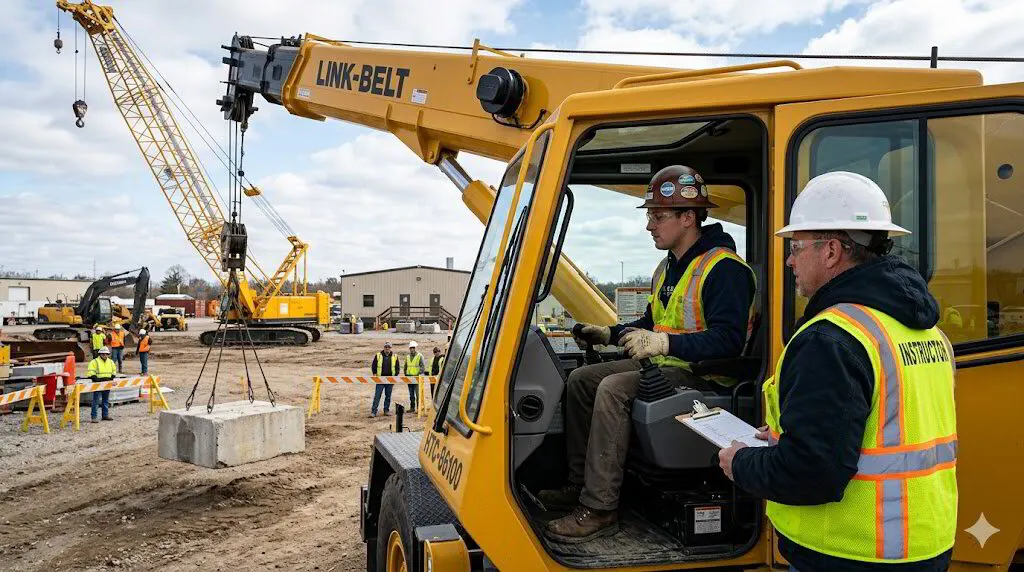
Miller Crane Works provides comprehensive practical training sessions designed to complement theoretical instruction and prepare students for both certification exams and professional practice. Our training sessions utilize modern, well-maintained equipment that reflects current industry standards and technologies. Students practice on various crane types, allowing them to develop versatility and understanding of different operational characteristics. Our experienced instructors provide individualized guidance, helping students develop proper techniques and overcome common operational challenges.
During practical training sessions, students can expect to progress through structured exercises that gradually build complexity and challenge. Initial sessions focus on basic control familiarization, allowing students to develop smooth, coordinated movements and understand equipment responses. Intermediate exercises introduce load handling techniques, precision positioning, and multi-step operational sequences. Advanced training scenarios simulate real-world challenges, including confined space operations, coordination with rigging crews, and emergency response procedures.
Practical training also emphasizes safety protocols and hazard recognition skills that are essential for professional practice. Students learn to conduct thorough pre-operational inspections, identify potential hazards, and implement appropriate safety measures. Emergency procedures are practiced regularly, ensuring students can respond effectively to equipment malfunctions, adverse weather conditions, or other unexpected situations that may arise during crane operations.
After Certification: Next Steps and Upskilling Opportunities
Achieving initial crane operator certification represents the beginning rather than the end of your professional development journey. Maintaining certification requires ongoing commitment to education, skill development, and compliance with evolving industry standards and regulations.
Recertification requirements ensure that certified operators maintain current knowledge and skills throughout their careers. NCCCO certification typically remains valid for five years, after which operators must complete recertification requirements to maintain their credentials. Recertification options include retaking written and practical examinations or completing approved continuing education programs. Many operators choose continuing education paths, as these programs provide opportunities to learn about new technologies, updated regulations, and advanced operational techniques while meeting recertification requirements.
Continuing education options available through reputable training providers offer valuable opportunities for skill enhancement and career advancement. Advanced courses cover specialized topics such as complex rigging techniques, multi-crane operations, and new crane technologies. Safety update courses ensure operators remain current with evolving OSHA standards and industry best practices. Technology training addresses new control systems, load monitoring equipment, and automation features increasingly common in modern crane operations.
Career advancement opportunities in crane operation are substantial for certified professionals who continue developing their skills and knowledge. Senior operator positions offer increased responsibility and higher compensation while providing opportunities to mentor newer operators. Supervisory roles such as crane coordinator or lift director involve planning and overseeing complex lifting operations. Some experienced operators transition into training instruction, sharing their knowledge with the next generation of crane professionals. Others pursue equipment sales, service, or consulting roles that leverage their operational expertise in different professional contexts.
Cross-training in related fields such as rigging, signal person duties, or equipment inspection provides additional career flexibility and value to employers. Pursuing leadership development and project management training can prepare operators for advancement into supervisory and management positions within construction companies.
Conclusion
Understanding how to become a certified crane operator in Texas requires navigating a comprehensive process that encompasses proper training, rigorous examination, and ongoing professional development. The journey from aspiring operator to certified professional demands dedication, study, and hands-on practice, but the rewards include excellent career prospects, competitive compensation, and the satisfaction of contributing to Texas's continued growth and development. With proper preparation, quality training, and commitment to safety and excellence, you can build a successful and rewarding career in crane operations.
Contact Miller Crane Works today to learn more about our comprehensive training programs and discover how we can help you achieve your certification goals. Visit https://millercraneworks.com/ to explore our course offerings and take the first step toward your new career in crane operations. Or, reach out directly via our Contact Us page.
-
 The Ultimate Guide to Crane Operator Field Training Programs: Certification & Career SuccessIn the ever-evolving construction industry, the need for certified crane operators is paramount, making effective…
-
 How Crane Simulators Enhance Operator Skills for Safer Construction PracticesAs the construction industry increasingly embraces technology, crane operator training has evolved significantly,…
-
 Unlocking Efficiency: The Benefits of Crane Simulator Training for Aspiring OperatorsCrane simulator training is revolutionizing the skill development of aspiring crane operators, offering a safe and…