When a company sends people to crane training, it is usually solving a compliance problem and a staffing problem at once. This post is for the superintendent, safety manager or owner deciding who needs what.
What OSHA expects of each role
OSHA's construction crane standard, 29 CFR 1926 Subpart CC, puts specific requirements on three roles:
- Operators must be certified for the type of crane they run, and the employer must also evaluate them on the equipment and document that evaluation (1926.1427).
- Riggers must be qualified for certain work, including rigging during assembly and disassembly and when workers are in the fall zone hooking, unhooking or guiding a load (1926.1404 and 1926.1425).
- Signal persons must be qualified, either through a third-party qualified evaluator or the employer's own qualified evaluator, and must know the signals and basic crane operation (1926.1428).
An audit or an incident investigation will ask for documentation on all three. Training is the part that makes the documentation mean something.
Sorting your people into the right course
A quick way to plan is to put each person into one of four groups:
| Person | Usual need |
|---|---|
| Laborer or apprentice who will help on crane days | Basic rigging and signaling knowledge |
| Crew lead who rigs and signals regularly | NCCCO Rigger Level I and Signalperson certification |
| Experienced operator without a current card | Focused exam preparation on the crane type they run |
| Employee moving into the seat for the first time | A full-length operator course |
Be realistic about the last group. Someone who has only watched crane work needs real seat time before the practical exam.
How group classes work
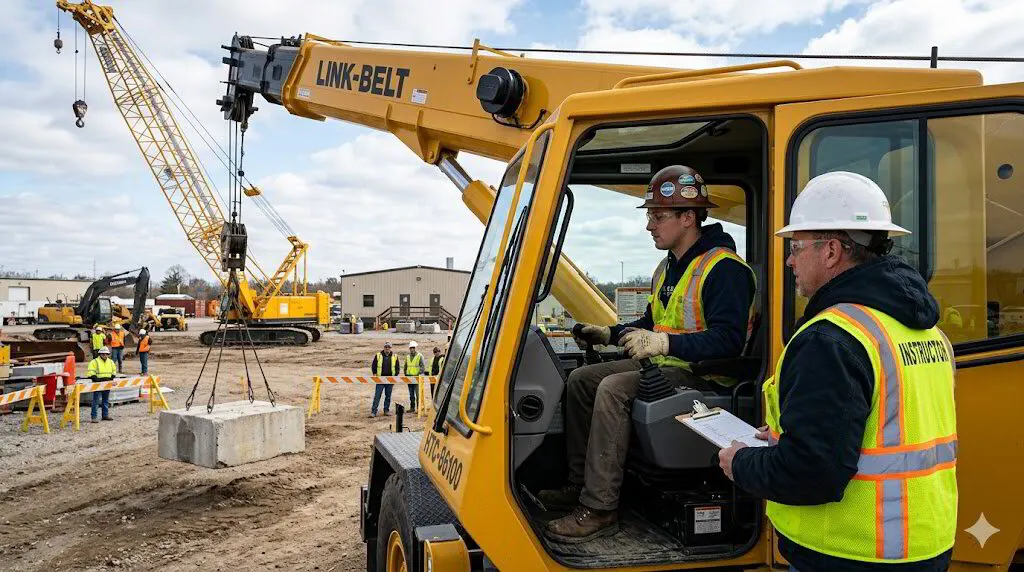
Companies can enroll several employees together. All classes are held at our facility at 304 Tunnell St in Seagoville, southeast of Dallas off US-175; we don't train at customer sites. Coming to our yard means your people learn on our cranes, practice on a laid-out exam course, and take the NCCCO practical exam in the same place. It also keeps your own equipment working on your jobs.
For scheduling and group details, see company classes or call (214) 763-0513.
Timing matters as much as the course. Many contractors schedule training for a slower stretch between projects, or stagger employees so a crane crew is never short on a lift day. If someone has an expiring card, plan their course and exams well ahead of the date rather than in the final weeks.
Who pays, and what to budget
Tuition for every course is published on the course pages and the funding page. When budgeting, also plan for:
- Wages for the days people are in class.
- Travel and lodging if your crew is coming from outside the Dallas area. Premium courses offer optional room and board.
- NCCCO exam fees, if they are billed separately for the course you choose. Ask us when you enroll.
- Time for your own employer evaluation after certification.Ask about hourly crane practice at the Seagoville yard if you want extra seat time. That time is a rental, not a course.
After training: closing the loop
- Collect copies of each person's certification or course completion record.
- Run and document your operator evaluations on the cranes they'll actually use.
- Record which employees are qualified riggers and signal persons, and on what basis.
- Put certification expiration dates into a tracking sheet, since NCCCO cards renew every five years.
Courses employers use most
For ground crews, the Miller Crane Works Level I Rigger/Signal Person 4 Hours course covers basic rigging, hand signals and voice communication; it is a Miller Crane Works qualification, not an NCCCO certification. Crew leads who need NCCCO credentials take Rigger/Signal Person Certification Level I 28 Hours. Experienced operators who need a card usually take Mobile Crane Operations Fixed/Swing Cab 40 Hours.
Questions we hear
Can Miller Crane Works train our crew at our job site?
No. All training and NCCCO practical exams take place at our yard in Seagoville, Texas. Crews travel to us.
Is the 4-hour rigger/signal person course an NCCCO certification?
No. It is a Miller Crane Works Level I qualification. The 28-hour course prepares people for NCCCO Rigger Level I and Signalperson exams.
Does NCCCO certification replace our own operator evaluation?
No. OSHA requires the employer to evaluate operators on the equipment they'll use and document it, in addition to certification.
Can our own staff qualify signal persons instead of sending them out?
OSHA allows signal persons to be qualified by a third-party qualified evaluator or by the employer's own qualified evaluator. Either way, the qualification must be documented, and many employers use outside certification to keep that simple.