
A good mobile crane course is more than hours in the seat. It should build seven connected skills, each of which shows up on the NCCCO exams and on every job afterward. Use this list to judge any program, including ours.
Skills 1 and 2: the machine and the rules
Knowing the machine
Before you touch a control, you need the vocabulary: boom sections, jib, outriggers and floats, counterweight, hoist drums, sheaves, hook block, load moment indicator and anti-two-block system. You also need to understand how a telescopic boom extends, the difference between a swing cab and a fixed cab, and what a rough-terrain crane does differently from an all-terrain or truck-mounted crane.
This isn't trivia. When a signal person calls for "boom down" versus "lower load", or when an inspection checklist asks about a specific sheave, you need to know exactly what is meant.
Rules and responsibilities
Operators work under OSHA's construction crane standard (29 CFR 1926 Subpart CC) and the ASME B30.5 standard for mobile cranes. Training should cover who is responsible for what: the controlling contractor for ground conditions, the operator for refusing an unsafe lift, the assembly/disassembly director when a crane is assembled or taken apart on site, and the requirements for working near power lines. The written exams test this material directly.
Skill 3: reading load charts
This is the skill that separates people who can operate from people who can operate safely. You should leave training able to:
- Select the right chart for the configuration: outriggers fully extended or not, counterweight installed, over the rear or over the side, on outriggers or on rubber.
- Find the radius and boom length, and handle values that fall between chart lines correctly.
- Subtract every deduction: hook block, slings and shackles, a stowed or erected jib.
- Recognize when the chart is limited by structural strength versus stability.
Expect plenty of worked problems in class. They take time, and that is the point.
Skill 4: set-up and inspection
Most crane accidents trace back to what happened before the lift: poor ground, outriggers not fully extended, missing mats, a crane out of level, or a defect nobody caught. Training should have you practice:
- A walk-around inspection with a checklist, including wire rope, hooks, latches and safety devices.
- Evaluating ground and placing mats or cribbing under floats.
- Leveling the crane and confirming it with the level indicator.
- Checking the swing radius for obstructions and setting up barricades.
- Identifying overhead power lines and keeping required clearances.
Skills 5 and 6: smooth control and communication
Smooth control
Controls on a hydraulic crane respond to small inputs. New operators tend to over-control, which swings the load. Good training builds control in steps: single functions first (hoist, boom, swing, telescope), then two functions together, then the combined moves you'll be tested on. The goal is a load that moves where you want and stops without swinging.
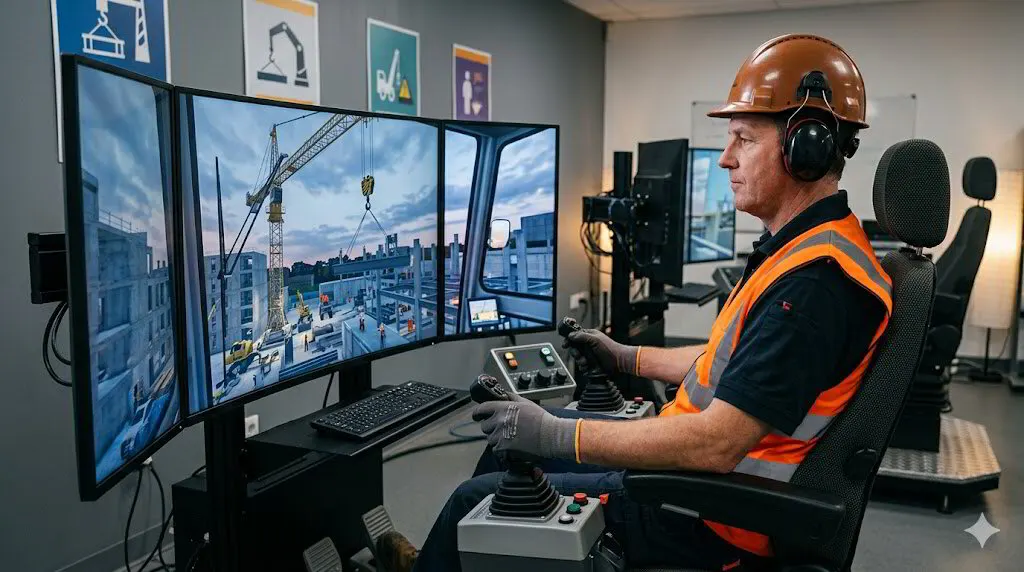
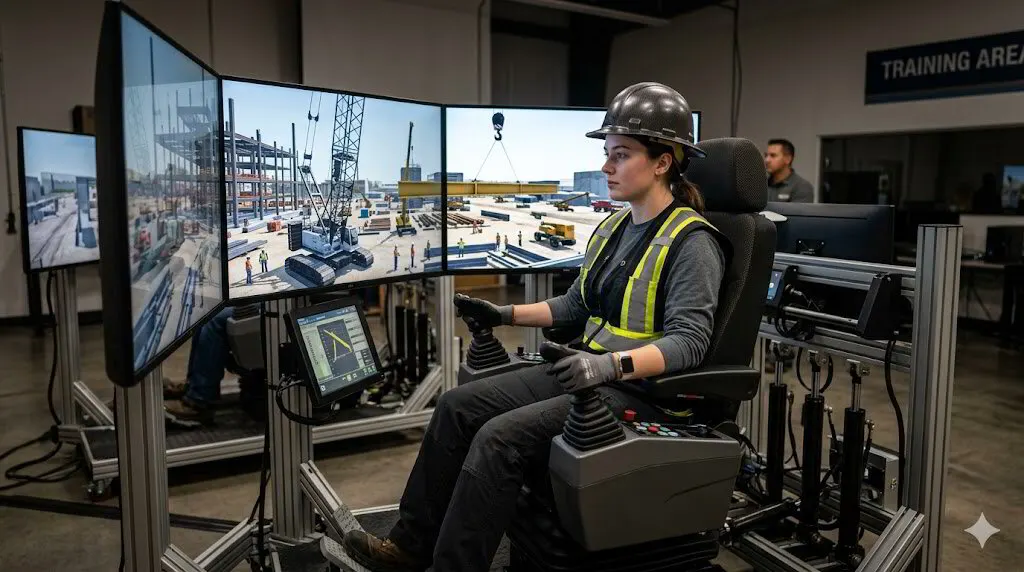
Simulator time early on lets you learn the control pattern without pressure, so your first yard hours go toward feel rather than finding the right lever.
Communication
The operator often can't see the load landing. Everything depends on the signal person. You need to know the standard hand signals for mobile cranes without hesitation, follow voice signals on a radio, and know that anyone can give the emergency stop signal and you must obey it. Training should include time with classmates acting as signal persons, so both sides practice.
Skill 7: the practical exam course, and where our courses fit
The practical exam course
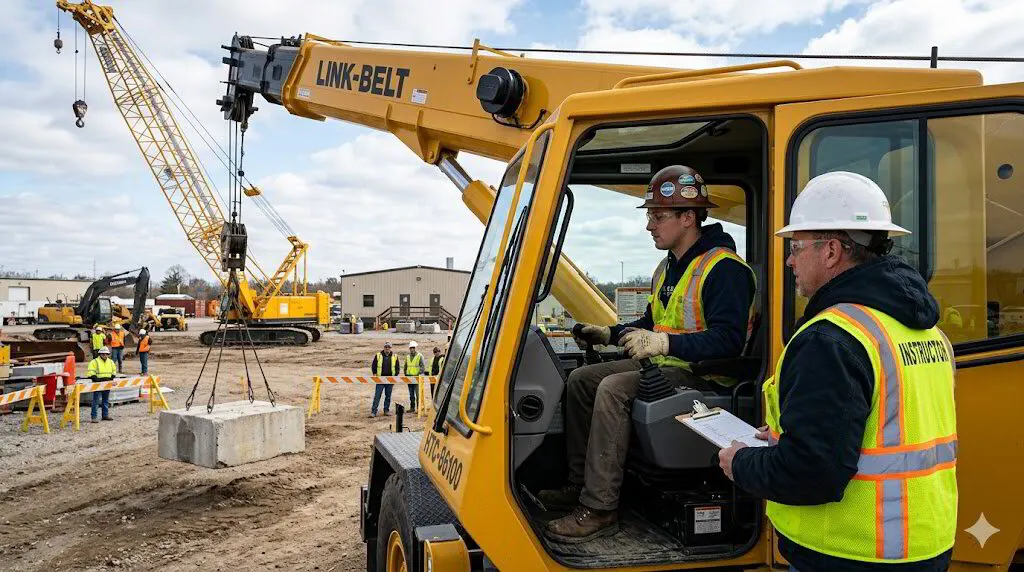
The NCCCO practical exam has you complete set tasks against the clock while an examiner scores you. Practicing on the actual course matters. At Miller Crane Works, NCCCO practical exams are given in the same Seagoville yard where you train, on the same cranes.
Practice runs should feel like the real thing: a timed attempt, a debrief on where you lost time or control, then another attempt. Knowing which tasks you tend to rush, and which make you hesitate, is the most useful thing you can learn in the last days before testing.
Where our courses fit
New operators usually choose Mobile Crane Operations Fixed/Swing Cab 120 Hours, which covers all seven skill areas with time to practice each. Students traveling from far away can take the Premium Mobile Crane Operations Fixed/Swing Cab Course, which offers optional room and board during training. See what to expect for the daily routine.
Questions we hear
How much of mobile crane training is classroom versus seat time?
It depends on the course length. Longer courses add more yard time, but every course includes classroom work on regulations and load charts because both are on the written exams.
Do I need to know how to read a load chart before I start?
No. Load charts are taught from the beginning, with worked problems that build up to the deductions and configurations tested on the NCCCO specialty exams.
Why train on a simulator if the yard has real cranes?
The simulator lets you learn the control layout and basic moves without pressure, so your yard time goes toward smooth control and the practical exam tasks.